Management Approach
The company aims to operate in the rubber industry in a way that creates value for every community where its facilities are located, encompassing economic value, improved quality of life for people in society, and a healthy environment within the community. To achieve this, it has established the 4Ds strategy: "Dedicate," which promotes development and participation from everyone in the workplace and in the local community, ensuring safety and well-being for all.
The company recognizes that its responsibility towards the community and society is crucial for business operations. Therefore, it has established ‘Social Responsibility Policy’ to ensure that all aspects of its operations comply strictly with relevant laws as well as environmental and social management guidelines. This aims to prevent and control any potential impacts from the company's operations that could pose risks or harm to society, the environment, safety, and health. Additionally, the company ensures accurate data management and provides accessible channels for disseminating information to the public, allowing stakeholders to conveniently access relevant information. The company also encourages community involvement by inviting feedback on projects that may affect the community, as well as suggestions or complaints arising from the company's activities. This initiative is part of the company's effort to build good relationships and support the development of the local community in various aspects.

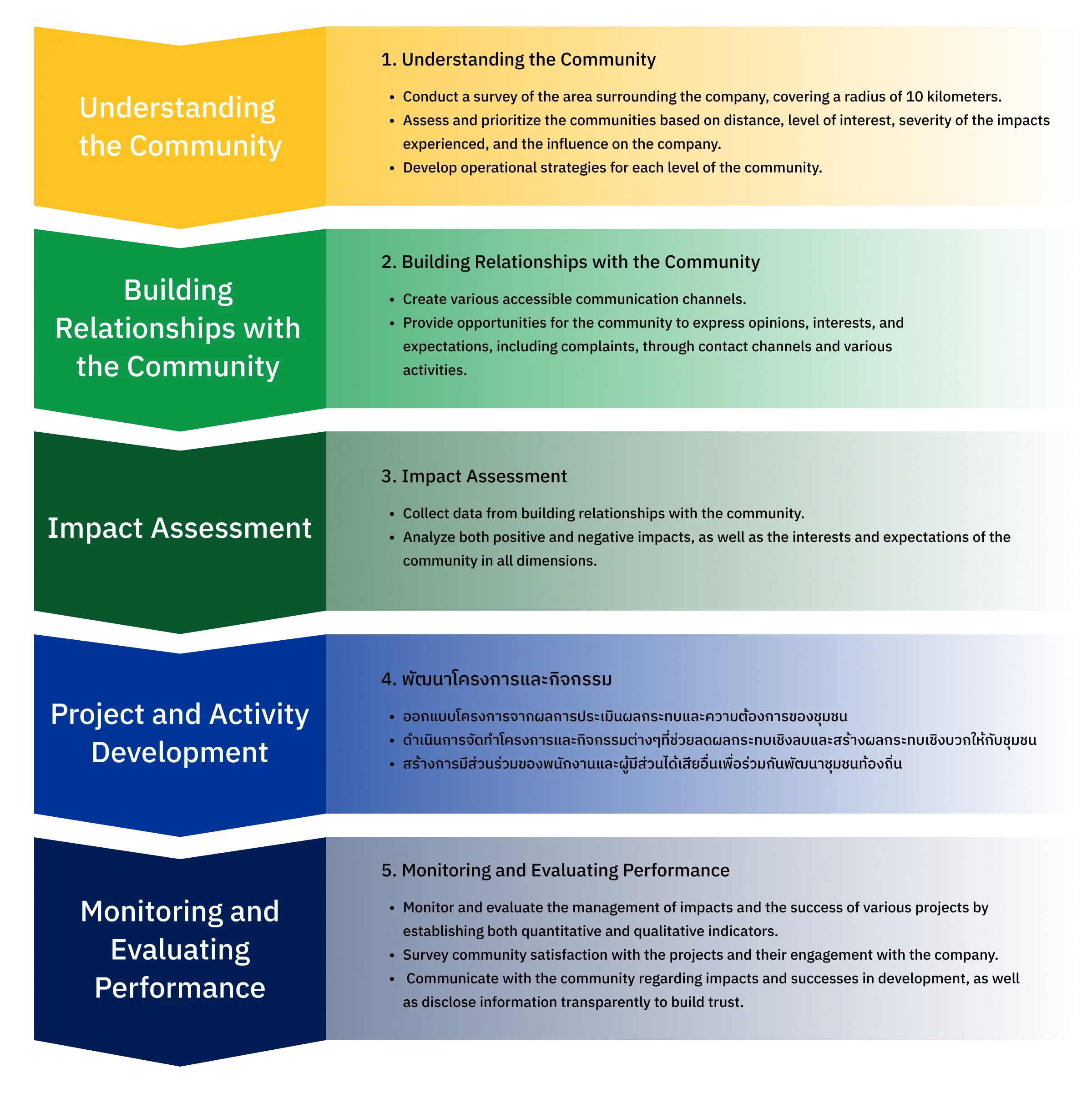
To ensure effective and efficient implementation of the policy, the company has established a Community Engagement Working Group, reporting directly to the Corporate Sustainability Development Committee. The group is chaired by Mr. Nattapon Inprakon, Assistant Vice President of Purchasing and Warehouse Management. It comprises 10 representatives from various departments, including Engineering, Production, Laboratory, Automotive, Marketing, Renewable Energy, Human Resources, and Warehouse. The group's responsibilities include studying and analyzing the community within a 10-kilometer radius of the company's operations, establishing connections and building relationships with the community, and analyzing impacts and expectations from the community. This information is used to plan and develop projects that support community engagement and development, along with tracking and addressing various issues related to the community. Additionally, the Community Engagement Working Group will promote and encourage awareness among employees to participate in corporate social responsibility activities. They will report on the progress of community engagement initiatives to senior management and the Corporate Governance and Sustainable Development Committee for acknowledgment and consideration, providing further guidance on operations.
Process for Managing Impact and Creating Value for the Community
The company has established a framework for community care and development that enables effective management of negative impacts while appropriately creating positive value for the community. This promotes sustainable relationships and acceptance from stakeholders. The process follows these steps:
Monitoring and Evaluating Performance
The company places great importance on monitoring and evaluating the various projects undertaken to utilize the gathered data for developing and improving initiatives that genuinely meet the community's needs. The Sustainability Development department and the community engagement working group have been assigned to conduct community satisfaction surveys through interviews and questionnaires. Surveys are conducted following the completion of projects to assess their effectiveness and identify areas for improvement, as well as to evaluate which projects received positive feedback or created significant social impacts warranting continuation in the future. The surveys are conducted by the community engagement working group using various methods, such as interviews and online questionnaires that can be easily accessed via QR codes. The questionnaires utilize a 5-point rating scale for evaluation and include open-ended questions for respondents to provide additional comments.
The survey results indicated that participants in the company’s activities rated their satisfaction with the various projects at an average of 86.33%, exceeding the community project satisfaction target set at a minimum of 80%. Participants also expressed a desire for the company to continue its projects to monitor changes within the community, particularly regarding healthcare for vulnerable groups in the community.
Additionally, raw material supplier farmers recommended that the company expand its local economic development promotion by supporting nearby farmers who cultivate crops other than rubber to increase their income. The company has therefore formulated a development plan for the "Smallholder Farmer Promotion Project Surrounding Operating Sites." Since the majority of these local farmers engage in rice and vegetable cultivation as their primary occupation, the project will focus on providing yield-enhancing technology and supporting local community enterprise groups. This initiative aims to improve agricultural efficiency, cut labor costs, and optimize farmland management, with the ultimate goal of enabling all farmer segments—regardless of their proximity to the operating sites—to achieve stable and sustainable growth.
Investments and Expenses for Community and Social Development
In 2025, the company implemented a total of seven main community development and engagement projects, along with five activities, within the target community area encompassing a radius of 10 kilometers (including 8 sub-districts, 43 villages, 24 schools, and 37 temples), with a total population of 60,042 people. A total of 28,212 participants from the community took part in these activities, representing 100% of the target community groups.
| Details | Community (sub-districts) | Population (Persons) | Vulnerable population (Persons) |
|---|---|---|---|
| Number of target communities and population | 8 | 60,042 | 547 |
| Number of communities and population participating in the programs/activites | 8 | 28,212 | 476 |
| Proportion of communities and population participating in the programs/activites within the target group/ | 100% | 46.99% | 87.02% |
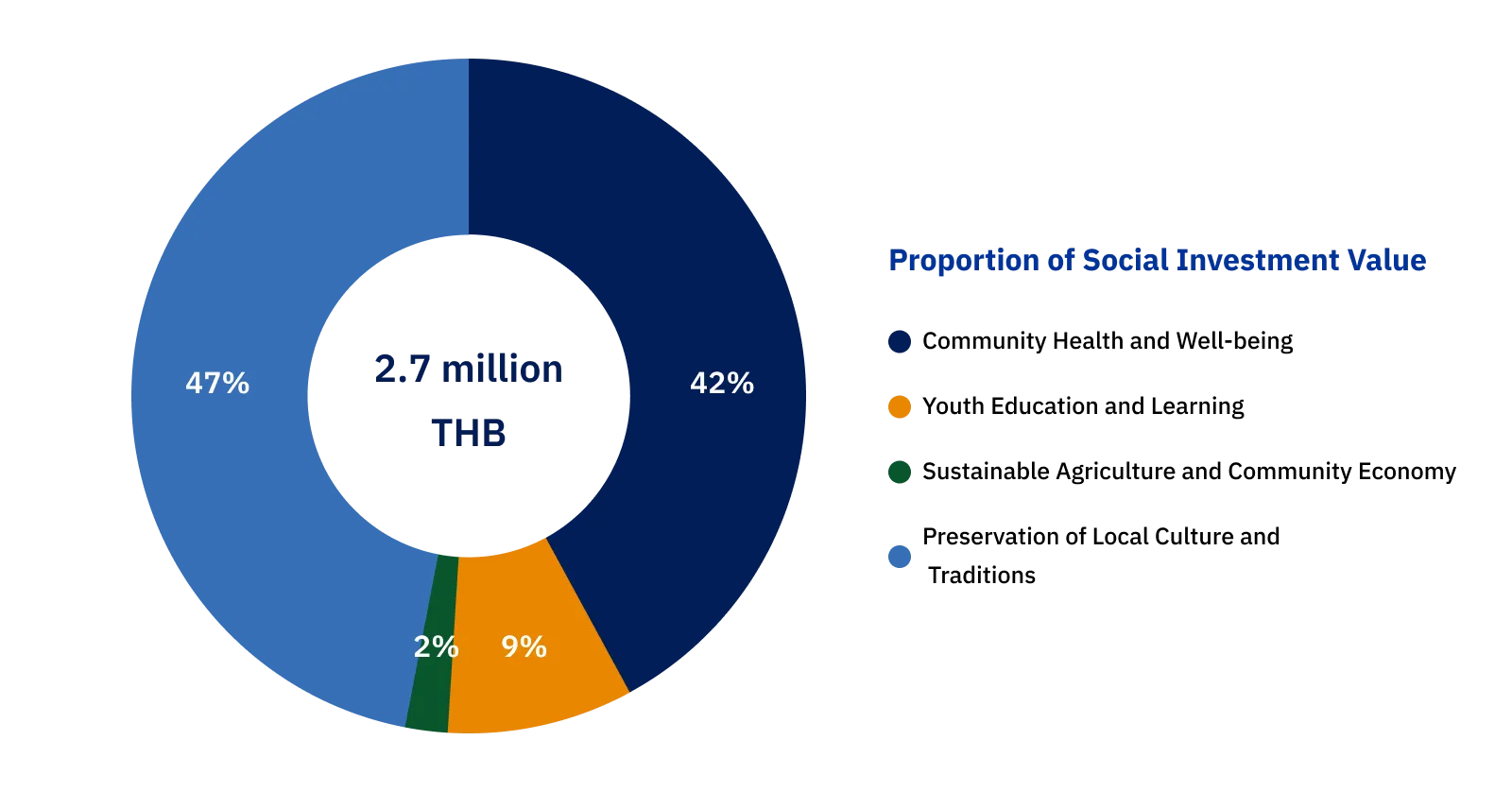
In 2025, the company allocated a total budget of 2.7 million THB for the implementation of community development projects and social investment activities. The proportion of social investment value, categorized in accordance with the company's operational framework, is as follows:
- Community Health and Well-being: 42%
- Youth Education and Learning: 9%
- Sustainable Agriculture and Community Economy: 2%
- Preservation of Local Culture and Traditions: 47%
| Number of NER employee volunteers participating in community activities (persons) | 189 |
| Total number of hours contributed by NER employee volunteers (hours) | 1,080 |
The company aims to increase employee roles and participation in community activities by 10% of the total number of participating employees by 2026, fostering stronger bonds among employees, the organization, and surrounding communities. To achieve this, the company has established mechanisms to support employee engagement in volunteer activities. This includes regular public relations campaigns through internal communication channels, the implementation of a rewards accumulation system (NER Point), and allowing employees to participate in activities during working hours as an incentive and a way to recognize their contributions.
Management of Community Complaints
The company places great importance on managing the impacts on the community and the environment resulting from its business operations, whether these activities are conducted by the company itself or by its contractors. To facilitate community and other stakeholders' feedback and complaints, the company has established a complaints channel and a complaint management process following the environmental procedures (QP-ENV-001). This allows the community and stakeholders to express their opinions and raise various issues directly.The company has defined a clear procedure for managing complaints that encompasses receiving the complaint, evaluating it for corrective actions, conducting meetings, summarizing solutions, and providing feedback to the individuals or organizations that lodged the complaints, along with appropriately and fairly remedying those affected. This process aims to build trust within the community and among stakeholders, demonstrating the company’s genuine intention to listen and respond to concerns or issues transparently and promptly. Furthermore, this approach allows the company to efficiently identify and manage problems, reducing negative impacts on the community and the environment and fostering strong relationships.
In 2025, the company received no complaints related to environmental impacts or the health and well-being of the local community. The company has verified with local government agencies to ensure that the community is not negatively affected by its operations and remains prepared to prevent any potential impacts on the community in all aspects moving forward. This reflects the company’s commitment to conducting business responsibly and genuinely creating positive impacts for the community.
Community Engagement
In 2025, the company conducted its first community engagement survey to assess the satisfaction and attitudes of local residents toward the company's operations. The results of this survey were utilized to identify strengths and weaknesses in building relationships with the community and to adjust strategies accordingly to better meet the needs and expectations of local residents. The company designated a community engagement working group to collect data through questionnaires and in-depth interviews, targeting individuals living within a 5-kilometer radius. This included three sub-districts and four villages: Ban Chai Phatthana and Ban Bat in Takotapi sub-district, Ban Krasang in Prathatbu sub-district, and Ban Khok Phet in Khok Ma sub-district. The sample consisted of 400 respondents, with one representative from each household.
The survey results indicated that community members place the highest importance on the community relations projects and activities organized by the company, and they acknowledged that the company is an integral part of the community, playing a significant role in supporting and improving the quality of life for local residents. The engagement score from the community towards the company was recorded at 74.60 which is lower than the set target of 90%. It was found that community members are still dissatisfied with environmental care and odor management, resulting in lower scores in these areas compared to other topics. The company will utilize these evaluation results to improve communication and more thoroughly disclose factual details regarding its environmental operations to the community. This will demonstrate the company's ongoing commitment to continuously enhancing the efficiency of odor management within its production processes. Furthermore, the company will increase joint environmental activities with the community to meet local expectations and further promote a healthy environment.

"In the early stages, the company faced quite a lot of issues regarding foul odors from the rubber, which affected most of the local villagers. However, the company demonstrated a genuine commitment to resolving the issue by initiating improvements to the odor filtration and wastewater treatment systems, listening to suggestions from villagers, and providing opportunities for local people to participate in the inspection process. Consequently, the odor has now significantly decreased. If the company can maintain this level of continuous performance, our community will certainly be able to coexist with peace of mind, and things will keep improving steadily.”
Mr. Marut Orasram
Environmentalist, Practitioner Level, Buriram Provincial Office of Natural Resources and Environment
The main goals and notable outcomes of the initiatives focused on Creating Value for Communities and Society are summarized in the table below.
| Long-term Goals 2030 |
2025 Goals | 2025 Performance |
|
|---|---|---|---|
| Community engagement score | Not less than 95% | Not less than 90% | 74.60% |
| Satisfaction score for community relationship activites | Not less than 100% | Not less than 90% | 96.11 |
| Significant conplaints from the community and local government agencies | 0 | 0 | 0 |