Management Approach
Water use and wastewater are critical issues that both stakeholders and the company prioritize, as they are essential natural resources for sustaining life and business operations. The company has established a 'Sustainable Water Resource Management Policy' to demonstrate its commitment to responsible water usage, reducing and preventing negative impacts on the environment and the rights of local communities to access freshwater resources. This policy also aims to promote and protect water resources throughout the value chain to support the implementation of this policy, the company is committed to continuously reducing water consumption and improving water use efficiency within its production processes. It has established a target to reduce its water consumption per production unit, or water intensity, by 20% by 2030 compared to the 2023 baseline year. Furthermore, the company has set a target to recycle 100% of its treated wastewater internally to minimize reliance on freshwater intake, reduce the volume of effluent discharged externally, and promote efficient water resource utilization in alignment with circular economy principles. In doing so, the company strictly adheres to the Factory Act, B.E. 2535 (1992), the effluent standards of the Pollution Control Department, and the ISO 14001:2015 Environmental Management System standard.

The company has established a Water Management Working Group composed of representatives from the Environmental and Production departments, chaired by Mr. Nattadet Chanaprakon, Engineering Manager. This group is responsible for assessing and analyzing water situation trends, evaluating risks associated with water management, creating plans, action plans, and budgets for water management, and monitoring water-related activities in production to align with the organization’s goals. Additionally, the group is tasked with sourcing water and increasing storage capacity for normal and crisis situations, as well as communicating to raise awareness about efficient water use among employees. The group reports directly to the Chief Executive Officer and provides regular performance updates to the management committee on a monthly basis.
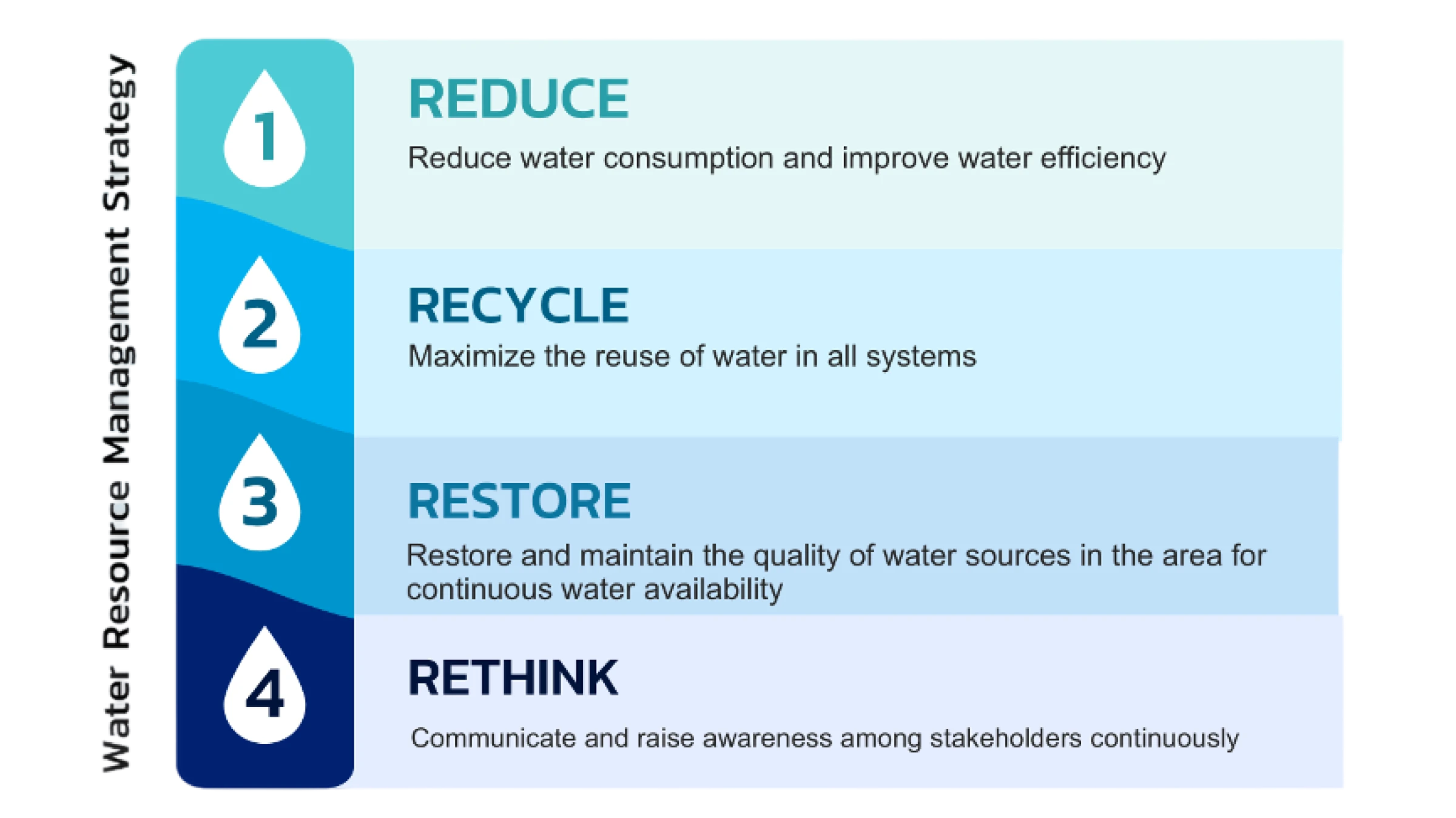
Water Resource Management Strategy
Based on the results of the water risk and impact assessment, combined with the context of the manufacturing plant in Buriram Province—which is located in an extremely high water stress area—the company has established a water resource management strategy under the "4Rs" concept. This strategy aims to enhance water efficiency, reduce reliance on fresh water, mitigate and prevent environmental and community impacts, and secure long-term water stability for business operations.
2025 Performance
Securing Water Stability
Buriram Province is an agricultural area in the Northeast region that relies primarily on rainfall and faces water quantity risks driven by climate variability—particularly droughts that could impact water adequacy for the agricultural sector, local communities, and industrial operations. Recognizing that its production processes consume a substantial amount of water, the company acknowledges the risk of water shortages under extreme climate change conditions, which could disrupt production continuity and lead to concerns or water-use conflicts with surrounding communities. Consequently, the company prioritizes securing water stability for its business operations by maintaining internal reserve water sources within its operational areas with a total capacity of 415,000 cubic meters, while refraining from withdrawing any water from community sources. The specific operational measures are as follows:
Internal Reserve Water Source Management
The company has excavated 3 seasonal rainwater retention ponds with a total capacity of 365,000 cubic meters to serve as reserve surface water sources for production and consumption activities within the plant. The company continuously monitors reserve water volumes and water consumption to assess water adequacy for operations, utilizing this data to support water management planning during the dry season or under conditions with lower-than-normal rainfall.
Water Recycling and Reuse
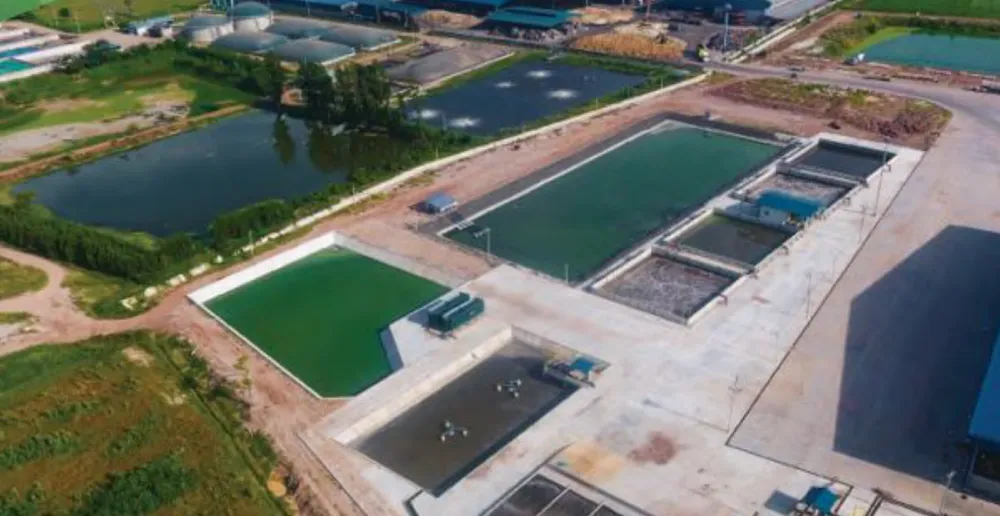
The company provides one treated water storage pond with a capacity of 50,000 cubic meters to collect all treated water from the production processes for recycling and enhancing water efficiency. In 2025, the company successfully recycled 100% of its treated water back into the production processes, aligning with its long-term water management targets and resulting in zero effluent discharge from the production processes into public water bodies. Furthermore, the company continuously monitors water quality to ensure that the recycled water meets the appropriate standards for use and does not cause adverse impacts on water sources, ecosystems, or surrounding communities.
Reserve Water Adequacy and Business Continuity
Through the management of internal reserve water sources and the water recycling system, the company has been able to operate continuously without experiencing any water shortage issues. Furthermore, based on the assessment of internal reserve water adequacy, the company estimates that the existing reserve water can support production processes for approximately 2.52 years in the event of a drought or water scarcity. This approach strengthens water stability, mitigates risks to production process continuity, reduces reliance on external water sources, decreases potential impacts on stakeholders sharing water resources in the area, and supports the company’s long-term business operations.
In 2025, the company primarily utilized water from internal reserve water sources within its operational areas for production processes. The consumption of surface water from the company's reserve ponds in Buriram Province amounted to 1,551,227 cubic meters, while municipal water consumption was only 62.5 cubic meters. This municipal water usage represents an insignificant proportion of the company's total water consumption and was utilized solely for supporting activities within the Bangkok office.
Water Reduction and Water Loss Mitigation within the Organization
The Company has set a target to reduce water consumption in both production processes and offices, and has therefore established the "NER Joint Effort for Sustainable Water Conservation Project." This initiative aims to encourage all employees to participate in conserving water resources and utilizing water efficiently across all activities. The Water Management Working Group is responsible for controlling and tracking the progress of various activities within the project as follows:
- The enhancement of water efficiency in the production process focuses particularly on the rubber washing and cleaning stage, which is an activity with high water consumption. The Production Department has therefore set a target to reduce the water intensity per production unit by 10% compared to the 2023 base year. Concurrently, operational procedures have been improved to minimize unnecessary water loss, such as controlling and preventing the opening of bottom drain valves while refilling water from the top of the rubber washing ponds, as well as determining cleaning cycles based on the actual turbidity or contamination levels of the water in the ponds rather than draining or cleaning on a fixed-time schedule.
- Continuous recording and monitoring of water consumption in the production process, alongside regular monthly reports to the Corporate Risk Management Working Group to track the Production Department's performance in controlling water usage against set targets and to evaluate the effectiveness of water reduction measures.
- Enhancing the water efficiency of equipment and sanitary ware, whereby the company selects and utilizes water-saving sanitary fixtures. Additionally, ball float valves have been installed in all water storage tanks to control water levels and prevent overflow issues.
- Inspecting and repairing water leaks in equipment and piping systems, under which the company inspects equipment and piping systems on a weekly basis and encourages all employees to participate in monitoring and reporting leaks for immediate repair if any water leakage is detected within the company, such as faucet or restroom fixture leaks.
- Educating and campaigning to raise employee awareness regarding water usage and conservation across all manufacturing plants and offices. The company organizes Morning Talk activities every Friday morning, held by the Environmental Department in collaboration with the Production Department, to build knowledge, understanding, and clarify water-saving measures for both offices and production processes. There are approximately 100 participants rotating according to their work shifts, and supervisors in each department are assigned to communicate the information to all employees who did not attend. Furthermore, the company has created promotional campaign signs to remind employees to turn off the water whenever it is not in use, regularly check for water leaks together, and use containers to hold water for washing dishes and cleaning equipment instead of washing directly from the faucet to reduce unnecessary water loss.
Wastewater Management and Recycling
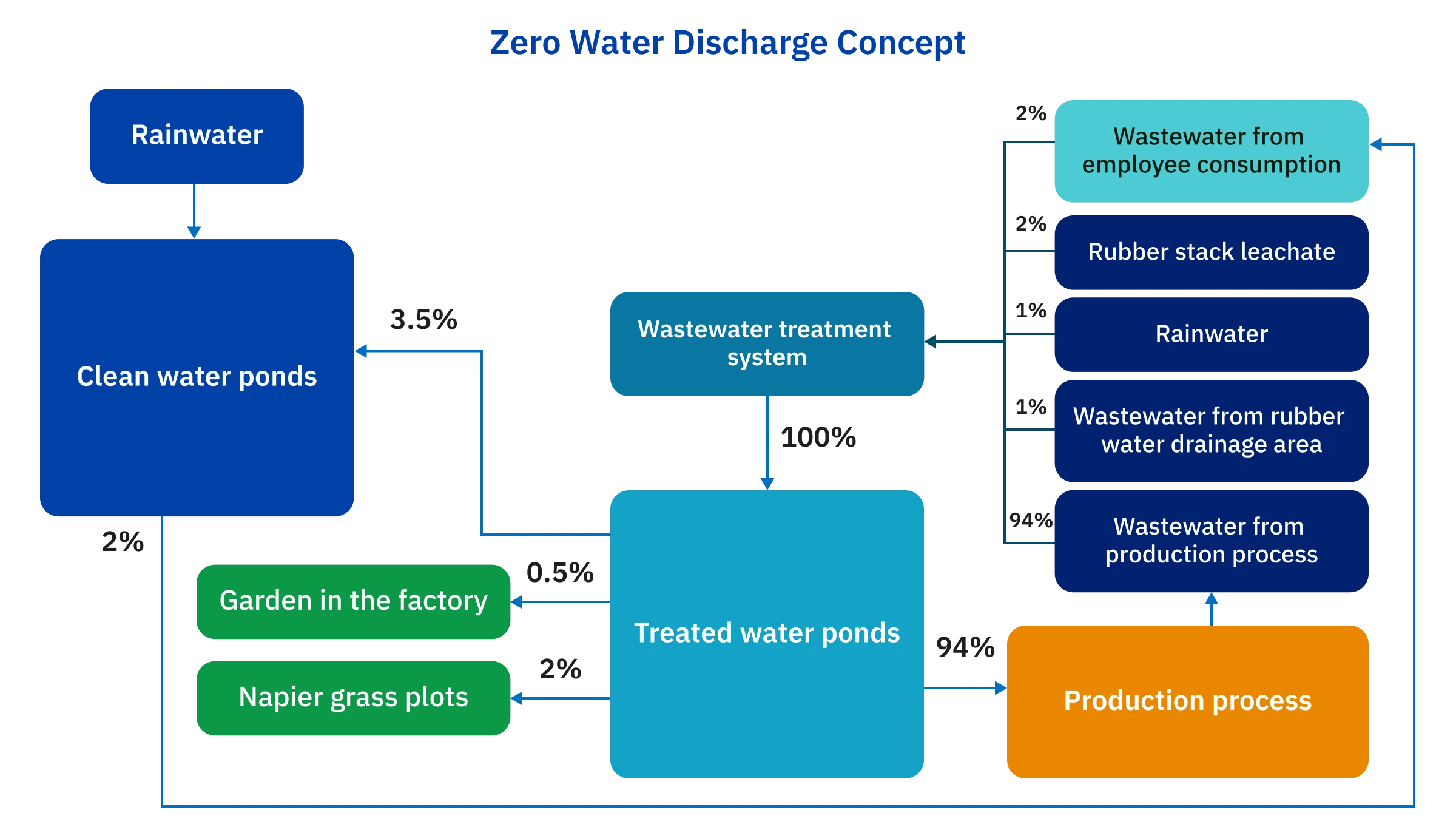
The company recognizes the risks posed to the environment and communities by wastewater management. It has therefore undertaken the collection of wastewater from all operational activities within the company’s areas of responsibility—namely, stabilization wastewater from cup lump rubber raw materials, rubber stockpiling wastewater, rubber manufacturing process wastewater, and domestic wastewater—in order to properly and efficiently manage and treat wastewater as follows:
Wastewater Treatment
The company has constructed a drainage channel system across all areas where operational activities generate wastewater—such as the production process, raw material soaking process, rubber stockpiling yard, stabilization yard, and utility water usage—enabling the collection of wastewater from all activities for routing into the treatment system. In 2025, the total volume of wastewater entering both treatment systems amounted to 1,551,227 cubic meters. This wastewater passed through the Phase 1 wastewater treatment system (STR 1 factory and livestock stall mat factory) and the Phase 2 wastewater treatment system (STR 2 factory), which have a combined treatment capacity of 15,000 cubic meters per day. The systems utilize both aerobic and anaerobic treatment processes to maximize wastewater treatment efficiency. Ultimately, 100% of the treated water, totaling 1,551,227 cubic meters, was sent to a treated water holding pond to be reused in the production process and for watering green areas and Napier grass plantations, achieving zero discharge into public waterways in accordance with Zero Water Discharge principles.
Water Quality Control
The company conducts monitoring to control the quality of treated wastewater, ensuring that the wastewater treatment system remains highly efficient and that the treated water can be reused without affecting production efficiency or product quality. The treated water is inspected daily by the company’s internal laboratory and monthly by a certified external organization.
In 2025, it was found that the treated water had an average Chemical Oxygen Demand (COD) of 124.75 milligrams per liter and a Biochemical Oxygen Demand (BOD) of 21.66 milligrams per liter, which were higher than the legally prescribed standards of not exceeding 120 milligrams per liter and not exceeding 20 milligrams per liter, respectively. Consequently, the company analyzed the root causes and accelerated improvements to the wastewater treatment system's efficiency, such as controlling the volume of wastewater entering the system, optimizing the aeration process, and increasing the frequency of water quality monitoring. Additionally, a preventive improvement plan has been established to bring water quality parameters back within the standard thresholds as quickly as possible. All treated water is retained in the treated water holding pond within the company's premises to be recycled in the production process, with absolutely no discharge into public water sources.
Stakeholder Engagement in Water Management
The company places great importance on stakeholder engagement in water and wastewater management, aiming to reduce reliance on external water sources, control water and wastewater quality, prevent impacts on surrounding areas, and foster a mutual understanding regarding responsible water usage approaches.
| Stakeholder Engagement Mechanisms | NER's Operations |
|---|---|
| Communication and Information Disclosure | Communicating policies, targets, and water management approaches—such as maintaining internal reserve water sources, recycling treated wastewater, and reducing reliance on external water sources—through community meetings, sustainability reports, and the company’s communication channels. |
| Gathering Stakeholder Feedback | Gathering and listening to feedback, concerns, and insights from local communities, suppliers, farmers, and stakeholders. This focuses particularly on issues that could affect agricultural areas, water sources, and the community's quality of life—such as seepage from retention ponds, rainwater runoff, and rubber wastewater leakage from raw material transport vehicles—in order to utilize this information for improving control and impact prevention measures. |
| Proactive Impact Prevention | Establishing risk control measures for water-related activities—such as monitoring water quality, maintaining drainage systems and retention ponds, managing wastewater, and requiring raw material transport vehicles to be equipped with leak-prevention devices—to mitigate contamination risks to the surrounding areas. |
| Coordination with Relevant Authorities | Coordinating with government agencies and local administrative organizations in the area as appropriate to ensure that the company’s water management aligns with the local context and appropriately supports shared water usage among the industrial sector, agricultural sector, and communities. |
| Grievance Channels and Response | Providing grievance channels for communities and stakeholders, alongside establishing a systematic process for fact-checking, assigning responsible parties, and responding to concerns related to water usage, wastewater, and impacts on the surrounding areas. |
Collaboration with Raw Material Suppliers
In addition to managing wastewater within its own processes, the company places significant emphasis on managing wastewater that is not generated by its operations but may contaminate the environment and impact the community. For example, latex spills from the trucks transporting rubber from agricultural suppliers can cause road accidents. Therefore, the company has established a policy and practices regarding the purchase and sale of cup lump rubber and has communicated these to agricultural suppliers comprehensively. Large banner signage has been installed at both the collection yard and the rubber water drainage area to inform all parties involved. It is mandated that all vehicles transporting rubber from suppliers must be equipped with drainage channels and containers to capture any rubber runoff to prevent spills during transportation. If this requirement is not met, the company will not accept rubber from those suppliers who do not comply with the policy. Additionally, the company has designated the rubber water drainage area as a parking space for rubber transport vehicles and has installed drainage systems to collect wastewater from the trucks for subsequent treatment. Through stringent enforcement of this policy, 100% of the company's cup lump rubber suppliers have adhered to the policy and successfully implemented systems to manage rubber wastewater properly.
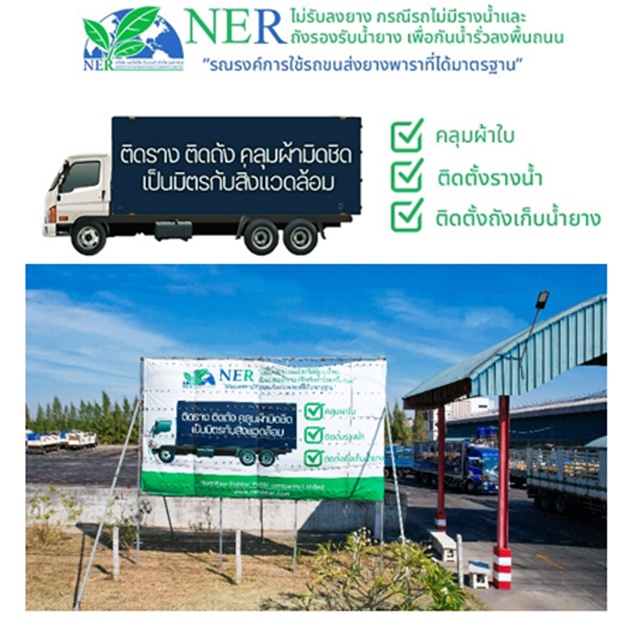
Building Engagement with Stakeholders
The company collaborates with surrounding communities to jointly inspect and monitor areas at risk of operational wastewater leakage contaminating community water sources or land. To ensure issues are resolved promptly and conveniently for the community, a grievance mechanism has been established via the company’s Line OpenChat group. Upon detecting an issue, the Environmental Working Group will conduct an on-site inspection to analyze the origin and root cause to determine if the problem stem from the company's operations. The team will also collect samples for initial testing, inform community leaders or representatives of the cause, and engage in mutual discussions regarding corrective actions, impact remedies, and future preventive measures to build trust with surrounding communities.
In 2025, the company found zero incidents of non-compliance with environmental laws and regulations concerning wastewater management, effluent discharge, and latex transport spillage prevention. There were no cases where the company was fined, penalized, or subjected to enforcement actions by relevant regulatory authorities. Furthermore, the company received no substantiated complaints from communities or stakeholders regarding impacts from wastewater or latex spillage from transport vehicles that caused distress to surrounding communities.
| Long-term goal 2030 |
2025 Targets |
2025 Performance |
|
|---|---|---|---|
| Reuse treated water within the company* | 100% | 100% | 100% |
| Reduce water intensity compared to the baseline year of 2023 | 20% | 10% | 14.76% |
* This applies exclusively to water consumed at the Buriram Province facility, as the Bangkok office is a leased space operating under the building's central water management system and is therefore unable to implement water recycling initiatives.
Operational Areas and Water Resource Risks
The company assesses the water resource context of its operational areas using the World Resources Institute's (WRI) Aqueduct Water Risk Atlas tool to evaluate water stress levels and water-related risks at the location of its Buriram Province production facility. The assessment indicates that the company’s production facility in Prakhon Chai District, Buriram Province—which spans 200 rais, or 32 hectares, and accounts for 100% of the company's total production area—is located in an Extremely High Water Stress Area.
Operating a business in an extremely high water stress area can present risks regarding water adequacy for production processes, water management costs, business continuity, and concerns among local stakeholders who share the same water resources. Consequently, the company prioritizes monitoring water situations, assessing the impacts of water withdrawal and consumption, and establishing efficient water management measures to minimize impacts on the business, community, ecosystem, and the environment.

In 2025, the company's water withdrawal from the extremely high water stress area totaled 1,551,227 cubic meters, marking an increase from 1,340,958 cubic meters in 2024. Consequently, the company continues to continuously monitor its water withdrawal and consumption volumes. This data will be utilized to support water impact assessments, plan for reserve water sources, enhance water use efficiency, and establish long-term measures to reduce reliance on freshwater intake.
| Water and wastewater | Lb.M. | |||
|---|---|---|---|---|
| 2022 | 2023 | 2024 | 2025 | |
| Total amount of water used | 2,035,319 | 1,951,951 | 1,340,958 | 1,551,289.5 |