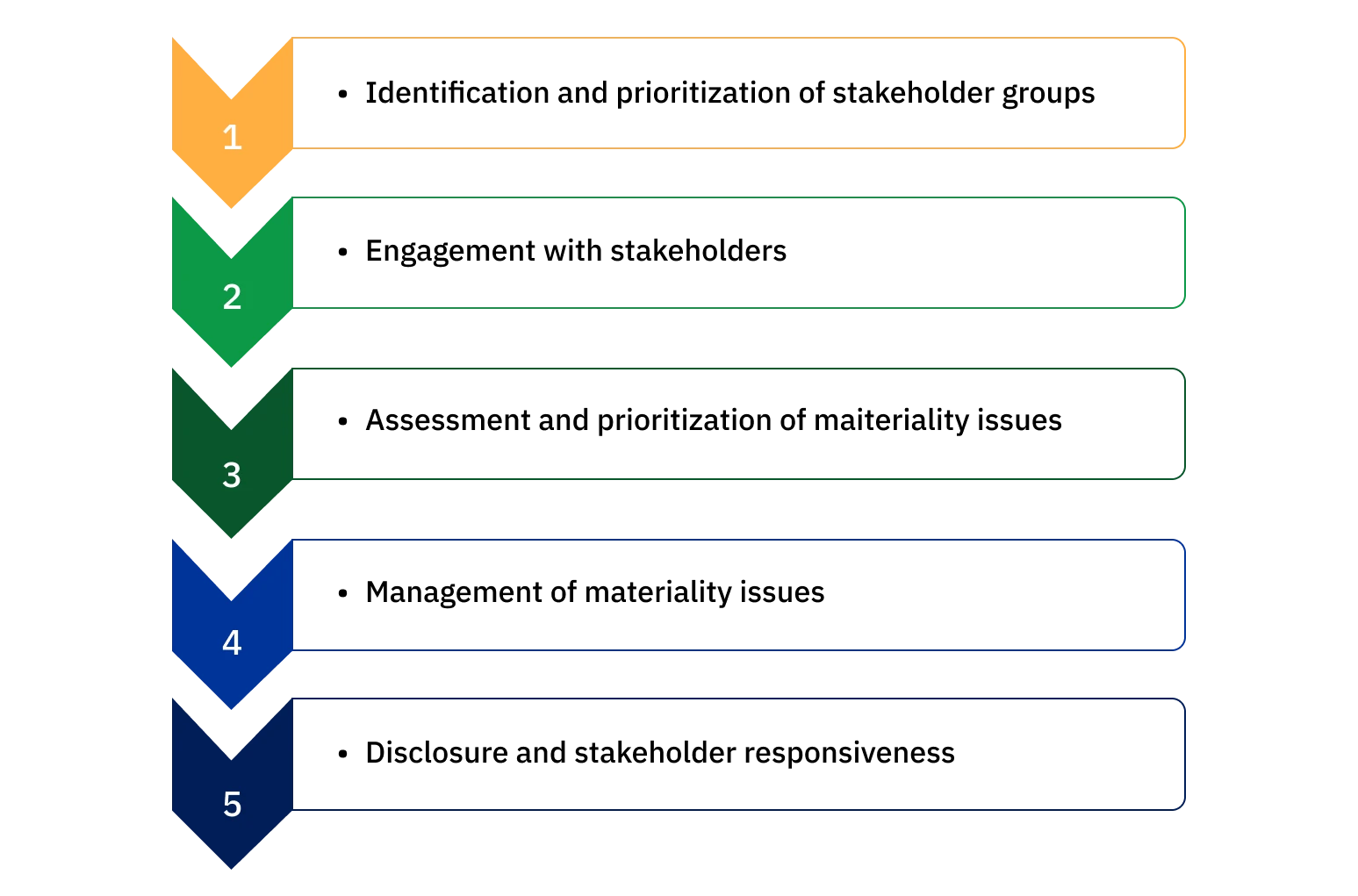
The company recognizes that both internal and external stakeholders are crucial for sustainable business operations, as they are affected or may be affected by the company's activities, or can create impacts or influence business operations. Therefore, the company emphasizes stakeholder involvement throughout the value chain, with operational processes for engaging stakeholders as follows:

Identification and Prioritization of Stakeholder Groups

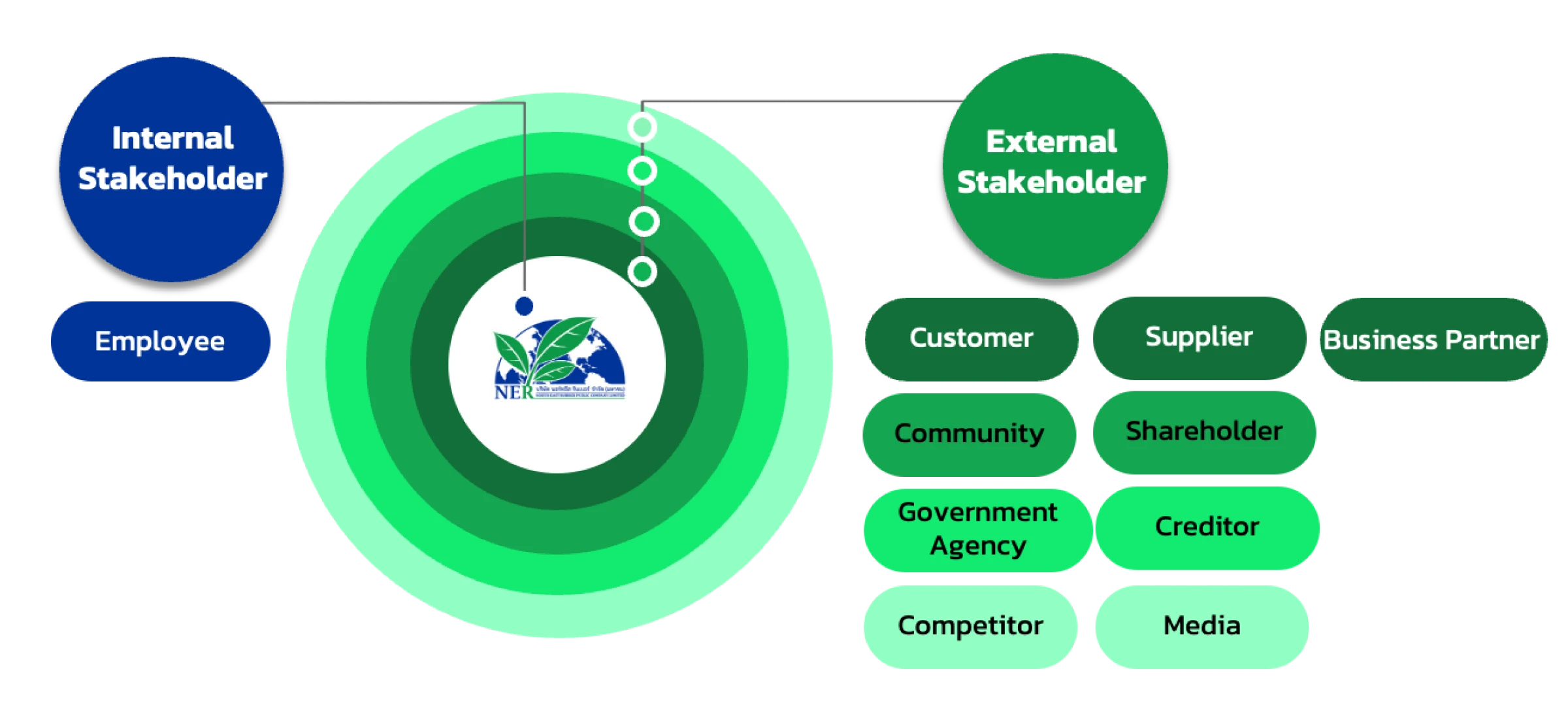
The company classifies its stakeholders in the value chain into eight groups, namely: employees, customers, suppliers, suppliers, regulators, shareholders, the community, creditors, and competitors. An internal stakeholder is employees, while external stakeholders consist of shareholders, customers, suppliers, the community, creditors, regulators, and competitors. The company prioritizes stakeholders based on the degree of impact of the company on each group concerning economic, social, environmental, and human rights aspects, along with the level of influence the stakeholders have on the company. This evaluation helps define approaches for building connections and engagement with stakeholders and planning appropriate operations tailored to each stakeholder group.
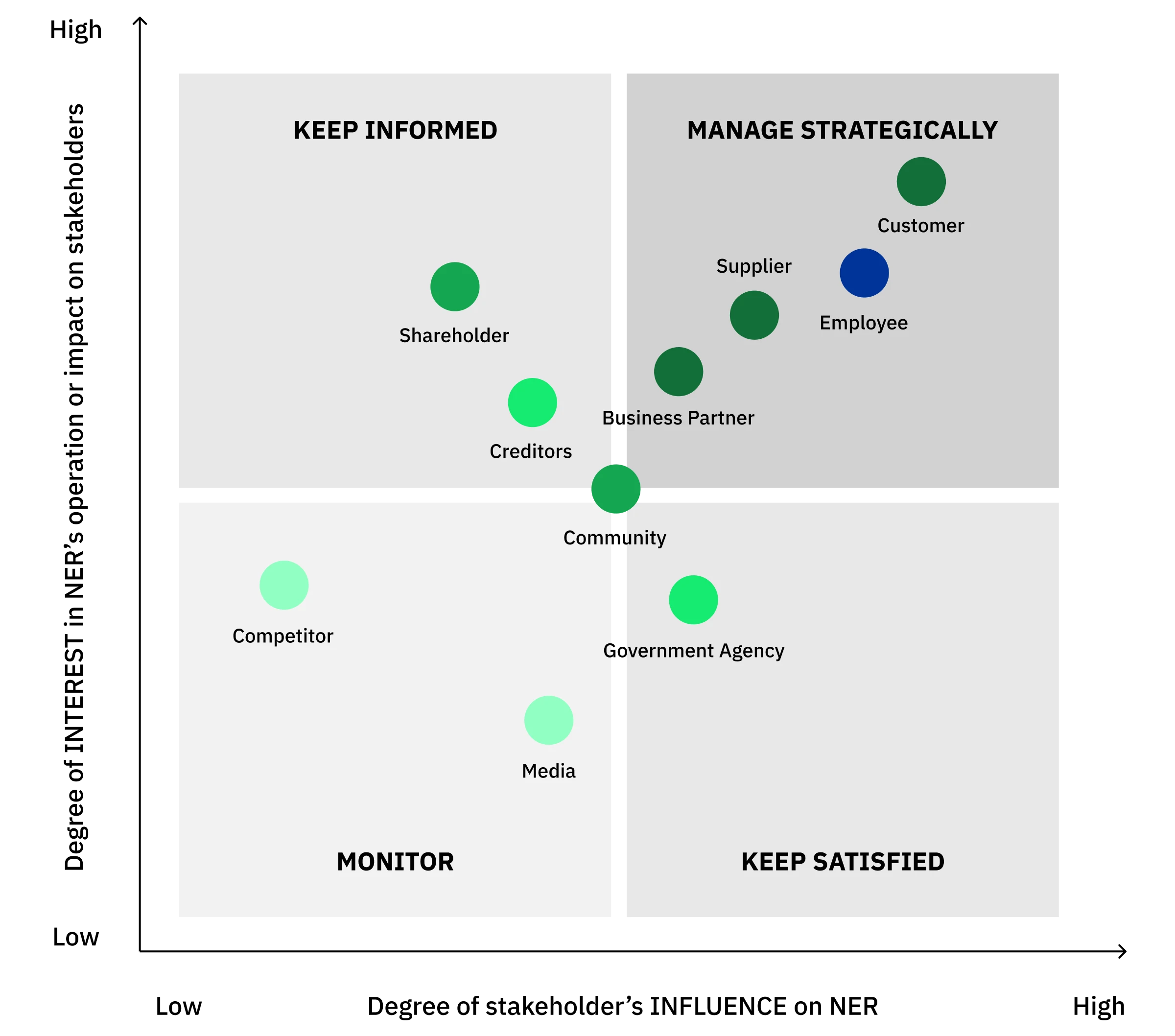
Based on the prioritization of stakeholders, the company has established stakeholder management strategies as follows:

  • Manage Strategically: Foster strong relationships and collaboration to align stakeholder interests with the organization's goals, thereby achieving mutual benefits and long-term success.
  • Keep Satisfied: Address the significant needs and concerns of stakeholders to maintain their support.
  • Keep Informed: Provide accurate information and communicate transparently and consistently to keep stakeholders informed of progress and build trust.
  • Monitor: Monitor and assess stakeholder interests and operations that may impact the company.

Engagement with Stakeholders

The company assigns departments responsible for each stakeholder group to systematically survey their needs and expectations through various communication channels at least once a year, under the oversight of the Corporate Sustainability Development Committee. This process aims to foster stakeholder engagement and survey the impacts experienced by each stakeholder group, including both existing and potential impacts, as well as concerns and expectations. The company collects and analyzes the expectations, needs, concerns, and comments from significant stakeholders that are relevant to its business operations. It evaluates materiality issues and develops management approaches to appropriately address these issues. In 2024, the company engaged and responded to stakeholders as follows:

Employees
Engagement Channels and Methods Needs / Expectations NER’s Responses
  1. Daily employee meetings before the start of work.
  2. Monthly Executive Committee meetings and departmental meetings.
  3. Quarterly Welfare Committee meetings.
  4. Employee engagement surveys that are conducted twice a year.
  5. Monthly Safety Committee meetings.
  6. Monthly Risk Management Working Group meetings.
  7. Communication through online media, intranet, and email.
  8. Whistleblower and complaint reporting channels via online media, email, and a Red Box for collecting complaints and feedback within the company.
Fair compensation and benefits
  • Conduct a survey to establish an appropriate salary structure at each job level, linking compensation to performance in operations to simultaneously increase production and revenue.
  • Enhance additional benefits, ensuring they align with the company's business performance, economic and social conditions.
  • Provide allowances and benefits suitable for roles and responsibilities, such as meal allowances, attendance bonuses, funeral assistance, get-well gifts, group life and accident insurance, provident fund contributions, uniforms, traveling and accommodation expenses, etc.
  • Ensure that benefits and various entitlements are provided appropriately, benchmarking against other companies in the same or similar industries, and in compliance with legal requirements.
  • Link performance evaluations to various compensation aspects fairly and appropriately, considering each employee's knowledge, skills, experience, position, responsibilities, and performance.
Transparent and fair performance evaluation
  • Improve the performance evaluation process to ensure transparency by using clear assessment criteria, averaging evaluations with input from supervisors at levels +1 and +2.
  • Provide employees with the opportunity to receive feedback on their evaluations and seek clarification from their supervisors.
Treatment of employees with respect for dignity, rights, and principles of human rights
  • Promote awareness of human rights and fundamental labor practices to executives and employees at all levels.
Job security and opportunities for career advancement
  • Establish clear career path plans for various positions within the company.
  • Encourage employees to enhance their skills and knowledge while providing opportunities to showcase their abilities.
Health and safety in the workplace
  • Improve the work environment to meet standards and promote good health and well-being.
  • Enhance workplace safety by assessing risk factors and improving equipment and the work environment, conducting safety training, and providing adequate PPE (Personal Protective Equipment) according to job nature.
  • Organize activities that promote both physical and mental well-being for employees.
Open communications and feedback
  • Create manuals, records, or documents to communicate policies and significant changes through Morning Talk and various communication channels, including bulletin boards, internal emails, intranet, Line Open Chat, and short video clips, to ensure communication is easy to understand, clear, and transparent.
  • Develop a systematic and clear process for handling complaints and suggestions that is easily accessible and communicates the results to employees.
Customers
Engagement Channels and Methods Needs / Expectations NER’s Responses
  1. Meetings/customer Visits
  2. Customer satisfaction surveys every 6 months
  3. Customer relations activities/marketing events
  4. Communication through online media, email, and telephone
  5. Channels for reporting complaints to the company
Products that meet quality standards and customer requirements
  • Organize customer visits to the factory to audit and gain confidence in the production processes and product quality.
  • Develop products and services that meet customer needs.
  • Ensure transparency in operational disclosures.
Timely delivery of products
  • Enhance systems for seamless integration across the organization to effectively plan sales, production, and delivery.
Flexibility in adhering to trade agreements
  • Adhere to trade agreements while maintaining some flexibility in certain cases.
High-quality and efficient service
  • Up skill the customer service team to provide comprehensive support with care and accountability towards customers.
  • Communicate, provide information, or respond to customer inquiries promptly and accurately.
  • Improve communication channels and complaint handling processes to effectively address customer complaints.
Maintenance of business confidentiality
  • Strictly adhere to the company’s Code of Conduct and policies.
Communities
Engagement Channels and Methods Needs / Expectations NER’s Responses
  1. Communication through online media, email, and telephone
  2. Meetings with community representatives held once a year
  3. Dialogues to gather feedback from the community held once a year
  4. Survey on community satisfaction and engagement conducted once a year
  5. Channels for reporting complaints to the company
Development of community economy and improvement of quality of life
  • Develop and support projects that enhance the quality of life and economic development of the local community.
  • Organize activities/projects to support the community during disasters or other social initiatives, such as donations for the community’s traditional events.
  • Build collaborative networks with other stakeholders to jointly develop the local community and society.
Job creation and employment opportunities for local residents
  • Promote the company‘s employment opportunities for local residents.
  • Promote and provide opportunities for local community members to access education and skill development to enhance their capabilities.
  • Provide knowledge on how to utilize by-products to create job opportunities for community members.
Road safety
  • Establish measures for transporting raw materials for suppliers and rubber farmers to ensure road safety.
  • Organize basic safe driving awareness activities for the community and stakeholders around the company.
Environmental quality in the community.
  • Strictly comply with environmental laws, regulations, and practices.
  • Monitor and control pollution measurement to ensure compliance with legal requirements.
  • Regularly assess environmental impacts on the community.
  • Disclose information regarding environmental and pollution management transparently.
Suppliers
Engagement Channels and Methods Needs / Expectations NER’s Responses
  1. Joint meetings with suppliers and rubber farmers held twice a year
  2. Regular visits to suppliers' premises every month
  3. Communication through online media, email, and telephone
  4. Channels for reporting complaints to the company
A transparent and fair procurement process
  • Establish guidelines, measures, and procedures for procurement that are transparent, open, and verifiable.
  • Conduct procurement activities transparently in accordance with the procurement policy and the anticorruption policy to ensure fairness for all parties involved.
  • Develop a raw material procurement system that treats both large and small suppliers equitably.
Compliance with laws and agreements
  • Comply with relevant laws and regulations, as well as the procurement policy and contracts or agreements between parties.
Timely and complete payments
  • Ensure payments are made according to the specified terms or credit terms outlined in the contract, adhering to principles of accuracy, transparency, and efficiency.
Development of capabilities and knowledge of suppliers
  • Develop programs to educate suppliers about the rubber quality and productivity improvement, as well as principles of human rights and new regulations, both domestic and international, that affect the rubber business.
Shareholders
Engagement Channels and Methods Needs / Expectations NER’s Responses
  1. Annual General Meeting of Shareholders and Extraordinary General Meeting of Shareholders
  2. Quarterly Analyst Meetings with securities analysts and fund managers
  3. Quarterly Opportunities Day activities of the Stock Exchange of Thailand
  4. Quarterly company Snapshot updates on the Stock Exchange of Thailand’s website
  5. Investor meetings at least once a year
  6. Business sites visit at least once a year
  7. Communication through online media, email, and telephone
  8. Channels for reporting complaints to the company
Accurate and transparent disclosure of the company’s performance in accordance with the rules of the Stock Exchange of Thailand and disclosure standards
  • Disclose information in periodic reports, including quarterly and annual financial statements, Management Discussion and Analysis (MD&A), summaries of the company’s performance and that of its subsidiaries (Form F45), and the 56-1 One Report, among others.
  • Prepare and disclose business operations, performance, and financial status transparently
  • Disclose information on significant events, such as shareholder meetings, asset acquisitions and disposals, related parties transactions, and various investments.
Maintaining financial stability and security of the company
  • Conduct business operations with caution while aligning with financial goals.
  • Closely monitor and oversee the company's financial status.
Treating all shareholders equitably
  • Provide information on performance and overall business growth to shareholders through accessible channels for all shareholders.
Achieving business growth and strong performance for good returns
  • Develop the business to maintain competitive costs and operational efficiency.
  • Enhance competitiveness through innovative products and new business ventures to ensure continuous revenue generation.
  • Seek and engage in joint investments with business partners to expand investment opportunities and build flexibility in operations.
Good corporate governance
  • Strictly comply with laws and regulations.
  • Operate with transparency and active anti- corruption.
  • Enhance effectiveness of the corporate governance and risk management structure and systems.
Creditors
Engagement Channels and Methods Needs / Expectations NER’s Responses
  1. Meetings with creditors.
  2. Business sites visit activities.
  3. Communication through online media, email, and telephone.
Effective risk management
  • Manage risks comprehensively, including economic, social, environmental, and human rights risks that may impact the company’s financial position.
  • Implement important internal control policy and procedures related to creditor transactions, as well as comply with auditors regarding the regular confirmation of balances during the accounting period.
  • Manage capital to maintain a suitable structure that supports the company’s business operations and preserves trust among creditors.
  • Communicate and disclose the company’s performance accurately and clearly.
Compliance with the terms of the loan and bond agreements / Repayment of debts according to the stipulated conditions.
  • Rigorously adhere to contracts and conditions, upholding accuracy, transparency, and timeliness.
  • Commit to maintaining sustainable relationships with creditors and fostering mutual trust.
Regulators
Engagement Channels and Methods Needs / Expectations NER’s Responses
  1. Participation in government-organized seminars related to the industry
  2. Business sites visit activities
  3. Communication through online media, email, and telephone
Collaboration and support for regulators.
  • Participate in meetings, seminars, or government programs that benefit the company, customers, and investors.
Compliance with laws and regulations.
  • Strictly comply with laws, regulations, and rules relevant to the industry.
Effective management of safety and environment in the factory.
  • Maintain environmental quality that exceeds legal requirements.
  • Prepare measures to respond to emergencies.
Commitment to social and environmental responsibility, coexisting sustainably with the community.
  • Build relationships with the community and regulators through various projects and activities aimed at social and environmental development.
  • Monitor and address the negative impacts that the community may experience from the company’s operations.
Good corporate governance.
  • Ensure that operations across all departments are conducted correctly, transparently, and are auditable.
Disclosure of the company's business performance.
  • Produce accurate business reports and publicly disclose them according to established timelines or provide information as requested by government agencies.
Competitor
Engagement Channels and Methods Needs / Expectations NER’s Responses
  1. Meetings and gatherings at organizations or agencies related to the industry.
Fair competition
  • Conduct business with ethics.
  • Treat competitors fairly within the framework of good competition practices and fairness.