Sustainability Policy and Framework
Given the nature of the business as part of the agriculture industry, it has both positive and negative impacts on the economy, society, the environment, and human rights, both directly and indirectly, currently or with potential future consequences. Therefore, the company is committed to developing its business to grow alongside maintaining a balance between the industry and surrounding communities, ensuring they coexist in a quality manner. This is grounded in a strict commitment to social and environmental responsibility, with a focus on creating value and improving the quality of life for local communities in all areas where the company operates.
The company has established a "Management and Sustainability Development Policy" to serve as the guiding principles and framework for driving responsible business growth while managing impacts and risks across economic, social, environmental, and governance dimensions. This policy aims to appropriately respond to the needs of all stakeholder groups and aligns with international sustainability practices and standards, including the Ten Principles of the UN Global Compact related to human rights, labor, environment, and anti-corruption. It also adheres to the United Nations Sustainable Development Goals (UN SDGs), the OECD Due Diligence Guidance for Responsible Business Conduct, the United Nations Guiding Principles on Business and Human Rights (UNGPs), and various ISO management system standards.
Learn more about the Management and Sustainability Development Policy at: www.nerubber.com or scan QR Code
In 2024, the company revised its vision and mission to reflect its commitment to conducting business that creates value and a sustainable future for every community it genuinely serves. In addition to being a provider of premium natural rubber products that effectively meet market demands, the company aims to create a sustainable future for all communities in which it operates by fostering talent, creating jobs, generating opportunities, and enhancing the quality of life for Thai rubber farmers and local community members, ensuring that they grow alongside the company in a stable manner.
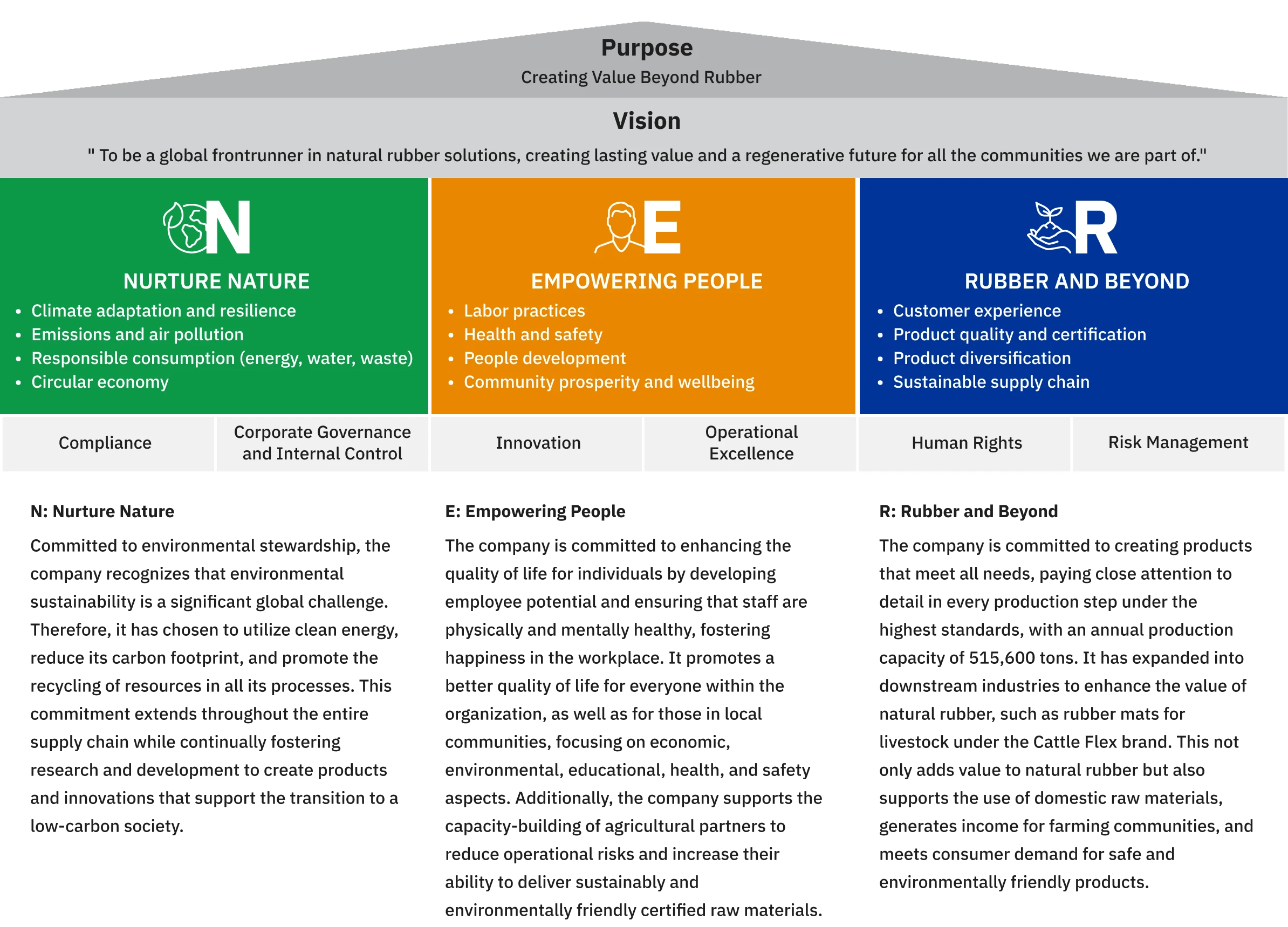
The company has established a "N.E.R. Sustainability Framework" to serve as a guideline for managing critical issues across all dimensions. The operations in all areas must be based on principles of corporate governance, compliance with laws and regulations, effective risk management, respect for human rights throughout the supply chain, innovation management, and operational excellence. This sustainability framework enables the company to set clear goals in each area and develop appropriate strategies and action plans to support long-term business growth while creating value for local communities and stakeholders in alignment with the company's purpose and vision. The details are as follows:
Establishing Strategies for Sustainability
In addition to considering sustainability materiality issues as part of the overall enterprise risk management to comprehensively manage risks and create business opportunities, the Corporate Sustainability Development Committee has also prioritized sustainability issues of strategic importance and integrated sustainability issue management into the business strategy. Consequently, the company has established a new strategy called the "4Ds Strategy" to guide its operations in achieving both short-term and long-term objectives and goals, as follows:
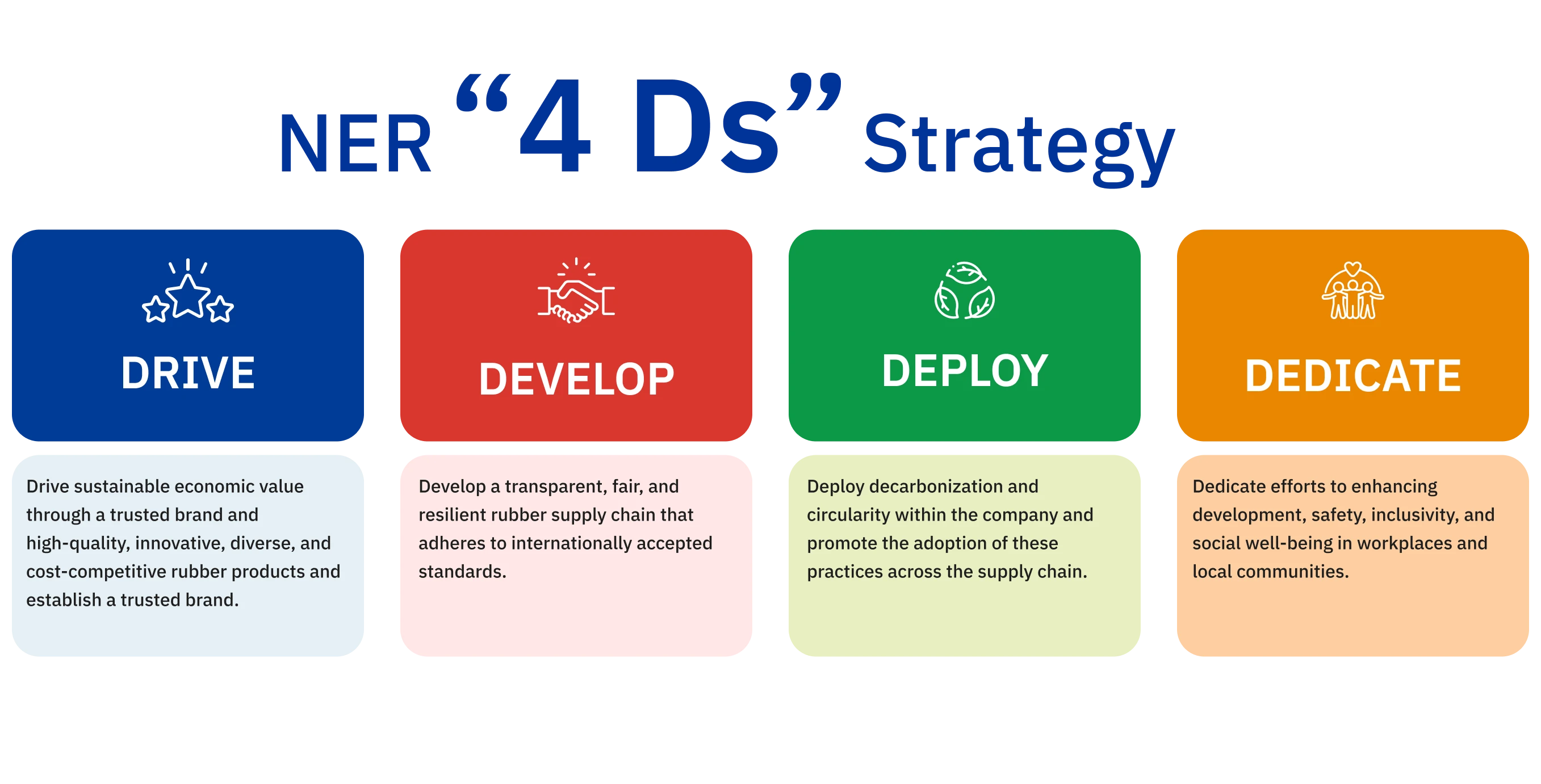
Produce and develop a wide range of high-quality rubber products through innovation and competitive cost advantages to create sustainable economic value and establish a trusted brand.
8.1, 8.2, 8.3, 8.4
9.4, 9.5, 9B
12.2, 12.5, 12.6

16.3, 16.5, 16.6, 16.7
17.17
| Goals |
NER’s Approaches |
- Increase revenue and market share
|
- Market penetration – existing market
- New frontier expansion – new markets and customers
- Invest in research and development of natural rubber products to increase added value and diversify offerings that meet the needs of target industries.
|
|
|
- Improve production efficiency through innovation and technology.
- Reduce waste generation rates.
- Maximize resources used.
|
- Become a trustworthy brand
- Customer satisfaction score exceeding 98% by 2030
- Zero product quality complaints from customers.
- Zero instances of non-compliance with economic, social, or environmental laws and regulations.
|
- Improve processes and standard certifications to enhance confidence in quality and safety.
- Provide a positive customer experience in purchasing both products and services.
- Disclose information transparently and ensure it is verifiable.
- Comply with laws and regulations, both domestically and internationally.
- Implement systematic and effective corporate governance.
- Promote stakeholder engagement for improvements and development
|
- Comprehensive and effective risk management across the entire organization (100%)
|
- Develop an enterprise risk management system that encompasses business risks and ESG Risks.
|
Develop a supply chain that is transparent, fair, flexible, and aligned with international quality standards.
2.3
3.9
5.2
8.3, 8.7, 8.8
10.3
12.4
15.1, 15.2
16.2, 16.5, 16.6
| Goals |
NER’s Approaches |
- Elevate product quality to meet global standards.
- Achieve international Carbon Footprint of Products (CFP) certification for finished low-carbon rubber products by 2028.
|
- Promote the use of raw materials from certified environmentally friendly sources, such as the EU Deforestation Regulation (EUDR) and the Forest Stewardship Council (FSC).
- Obtain various certifications that demonstrate responsibility and a commitment to sustainable rubber business practices in accordance with international standards.
- Reduce raw material contamination.
- Ensure the stability of raw material supply.
|
- Increase the proportion of raw materials from small suppliers to exceed 30% of total production by 2030.
|
- Promote raw materials sourcing from small suppliers.
- Develop the accurate and transparent raw material procurement process for the benefit of small suppliers.
|
- Increase the proportion of key suppliers undergoing sustainability risk assessments to 100% by 2030.
|
- Develop a data process and system to trace back the origin of raw materials.
|
- No human rights violations in the supply chain
- Zero instances of child labor or forced labor within the supply chain.
- Increase the proportion of key suppliers undergoing sustainability risk assessments to 100% by 2030.
|
- Develop a comprehensive supplier risk assessment system that covers economic, social, environmental, and governance risks.
- Regularly assess and monitor supplier risks.
|
Reduce carbon footprint and promote the reuse of resources in all processes of the company, extending the scope to the entire supply chain.
3.9
6.3, 6.4
7.2, 7.3
8.4
9.4
11.6
12.2, 12.4, 12.5
13.1, 13.2
15.1
| Goals |
NER’s Approaches |
- Become Carbon Neutrality by 2030.
- Reduce greenhouse gas emissions (Scope 1 & 2) by 22.5% compared to the baseline year of 2021 by 2030.
- Reduce Scope 3 indirect greenhouse gas emissions from purchased goods and services by 25% by 2030, compared to the 2021 base year.
- Reduce energy intensity (energy consumption per unit of production) by 30% by 2030, compared to the 2023 base year.
Increase the proportion of renewable energy to at least 60% of total energy consumption by 2030. |
- Reduce greenhouse gas emissions in the production process.
- Reduce greenhouse gas emissions from transportation.
- Encourage suppliers to reduce greenhouse gas emissions within the supply chain.
- Increase the production and proportion of renewable energy and biomass energy to replace fossil fuel energy.
- Seek certification for greenhouse gas emissions reduction targets in accordance with Science Based Targets Initiative (SBTi) by 2030
- Implementation of carbon credit offset projects from the agricultural sector
|
- Zero Waste to Landfill by 2030 Achieve a 100% waste diversion rate by 2030, ensuring all generated waste is recovered and utilized.
|
- Develop innovative processes and technologies to facilitate the recovery and repurposing of production waste into new materials or alternative products.
- Increase the recycling rate of residual materials, refuse, and industrial waste generated throughout the organization’s manufacturing processes.
- Collaborate with suppliers to develop environmentally friendly packaging. Digitize documentation workflows and transition to online systems to enhance operational agility, reduce processing time, and minimize the consumption of consumables.
|
- Achieve 100% water reclamation by recycling and reusing all treated wastewater within the company’s operations
- Use 100% recycled water in production.
- Reduce water intensity by 20% compared to the baseline year of 2023 by 2030.
|
- Develop water management technology to reduce water consumption in the production process.
- Enhance the efficiency of advanced wastewater treatment systems to improve the quality of reclaimed water for reuse and integrate it into freshwater reservoirs to maximize water reserves for the production process.
|
Promote the development and engagement of everyone in the workplace and in the local community for the safety and well-being of all.
1.1
2.3
3.4, 3.5, 3.6, 3.9

4.4, 4.5
5.5
8.3, 8.5, 8.8
9.2
10.3
16.1
17.16, 17.17
| Goals |
NER’s Approaches |
- Have sufficient employees in both number and capability to support future business expansion.
- Average training hours not less than 30 hours per person per year by 2030.
|
- Implement a Talent Development Program for high-potential employees.
- Create Individual Development Plans (IDPs) for employees at all levels.
- Develop employees’ soft skills in addition to their technical knowledge and expertise.
|
- Employee engagement score not less than 95% by 2030.
- Voluntary turnover rate of less than 2.5% by 2030.
|
- Strengthen employee engagement and involvement.
- Develop activity programs to promote the quality of life and well-being of employees.
|
- Zero rate of fatalities or disabilities from workplace accidents (Zero major accidents).
- Zero occupational illnesses.
- Zero Lost Time Injury Frequency Rate (LTIFR).
|
- Develop a risk assessment system for work processes and establish effective risk management and prevention measures.
- Foster a safety culture (Safety DNA) and ensure compliance with various procedures and measures among employees.
|
- No complaints regarding air pollution from the community or government agencies.
- Community engagement score exceeding 95% by 2030.
- Achieve a 100% satisfaction score from community engagement activities by 2030.
- Improve the well-being and quality of life of community members.
|
- Monitor and assess the impacts of business operations on the community.
- Promote environmentally friendly agricultural practices among rubber farmers to produce high-quality, clean rubber and encourage the use of non-hazardous chemicals.
- Initiate and implement community development projects to enhance the potential and well-being of local residents, such as creating job opportunities, promoting health and wellness, supporting education, and preserving cultural traditions.
- Build partnerships with non-profit organizations to amplify positive social impacts.
|