Management Approach
The company places great importance on effective waste management within the organization, as it not only minimizes the impact of business operations on the environment and surrounding communities but also enables the company to produce high-quality natural rubber with a cost advantage. Therefore, the company has established an 'Industrial Waste Management Policy' that mandates all departments to strictly comply with relevant laws and regulations concerning waste management. It is committed to minimizing the amount of waste generated and increasing the proportion of waste repurposed through circular economy principles, with the goal of reducing the amount of waste sent to landfills to zero. Additionally, the company promotes collaboration with stakeholders throughout the supply chain to enhance their understanding of waste management processes, including collection, segregation, and recycling, to foster sustainability in operations.
The company has assigned an Environmental Working Group, which reports directly to the Corporate Sustainability Development Committee, with Mr. Ekaphong Duang-arch, the Environmental Manager, serving as the head of this group. This group is responsible for overseeing and monitoring operations across the organization to ensure compliance with the policy to achieve stated goals. The policy will be reviewed at least once a year to ensure its effectiveness and alignment with changes in the company's operational processes.

The company manages waste in accordance with legal requirements in Thailand, such as the Factory Act, B.E. 2535 (1992) and other relevant environmental laws, utilizing the ISO 14001:2015 environmental management system as a framework to systematically control and manage both hazardous and non-hazardous waste. The company also undergoes monitoring, inspection, and environmental performance evaluation by relevant external agencies, such as the Department of Industrial Works and the Buriram Provincial Office of Natural Resources and Environment, to ensure that waste management operations comply with laws, standards, and related regulations.
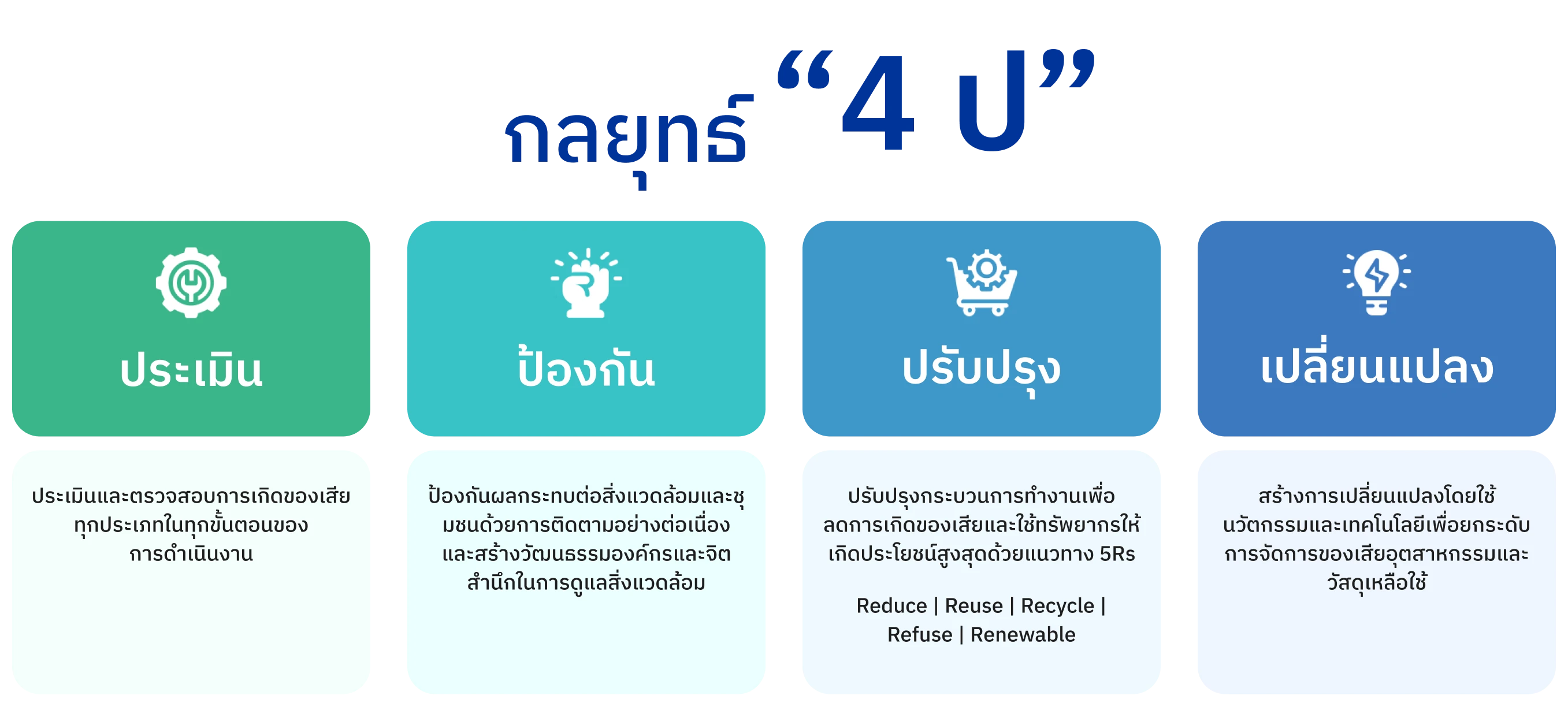
Beyond complying with waste management laws and regulations, the company has voluntarily established targets to enhance resource efficiency based on the Circular Economy concept, aiming to reduce the use of virgin raw materials, lower dependence on waste disposal via landfilling, and increase the proportion of waste and residual materials with potential to be utilized for maximum value. The company applies the Circular Economy principles and the 5Rs approach—consisting of Reduce (reducing resource use), Reuse (reusing materials), Recycle (processing for reuse), Refuse (avoiding environmentally unfriendly materials or substances), and Renewable (utilizing renewable resources)—in conjunction with its "4Rs" strategy: "Re-assess, Restrain, Refine, and Replace" to systematically manage garbage and waste, mitigate potential risk impacts on surrounding communities and the environment, and promote worthwhile resource utilization.
Furthermore, the company has set a long-term target within 2030 to reduce the proportion of waste sent to landfills to 0% and increase the proportion of waste utilized to 100% of the total waste volume. This target supports the reduction of virgin resource use by bringing waste and residual materials back for utilization in the production process or other appropriate forms of utilization, instead of sending them for final disposal.
2025 Performance
Volume and Types of Waste
In 2025, the company experienced a fire incident within the factory premises, resulting in waste generated from damage to raw materials, semi-finished products, packaging, and related materials and equipment, as well as buildings and facilities. This caused a significant change in the reported waste volume compared to the company's normal operations in the past. The waste generated from the fire incident is classified under waste from production processes, categorized as non-hazardous waste which includes burnt rubber scraps and concrete debris, as well as waste from contractors entering the site to demolish, clean up, and repair various sections affected by the fire. Meanwhile, the burnt solar panels are classified as hazardous waste.
The company prioritizes the management of waste resulting from this incident by implementing segregation, utilization, and disposal through authorized disposal operators to control environmental and community impacts. In this regard, the company considers the increase in waste volume in 2025 to be a one-off incident that does not reflect waste management efficiency under normal operating conditions.
All waste generated from the company's business operations can be classified by waste type, namely hazardous waste and non-hazardous waste, and classified by source of waste generation, namely waste from production processes and offices, and waste from employee consumption. In 2025, the company generated a total volume of waste and refuse of 3,034.47 tons, a significant increase of 84.87% from 2024 due to the fire incident, which is divided into 38.73 tons of hazardous waste and 2,995.74 tons of non-hazardous waste, accounting for a proportion of 1.28% and 98.72%, respectively.
| From production processes and offices (tons) |
% | From employee consumption (tons) |
% | |
|---|---|---|---|---|
| Hazardous waste | 38.73 | 1.28 | 0 | 0 |
| Non-hazardous waste | 2,995.74 | 98.72 | 92.25 | 100 |
| Total | 3,034.47 | 100 | 92.25 | 100 |
Management of Various Types of Waste has the following performance results:
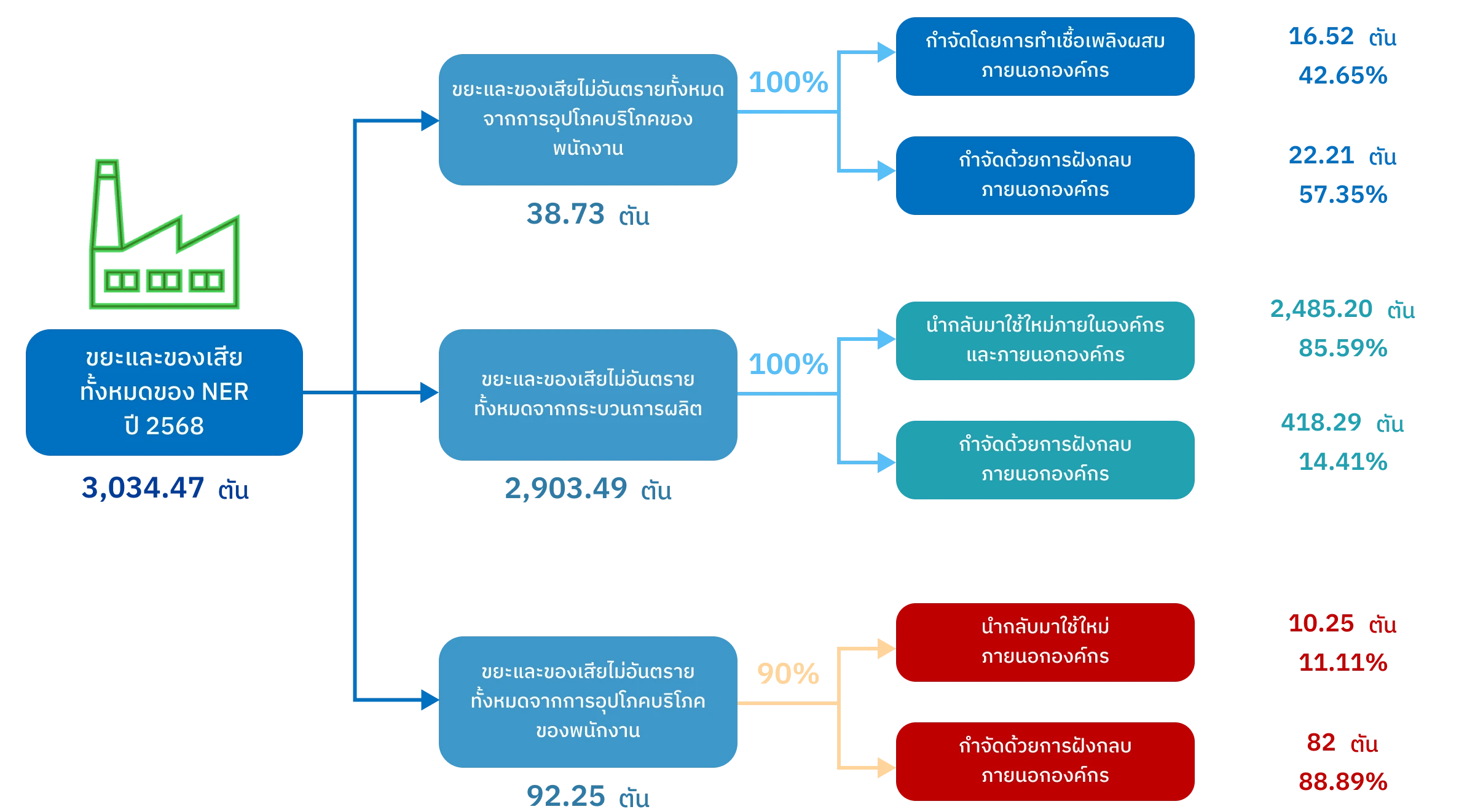
The Company has reported 100% waste data coverage for its operational area in Buriram Province. A summary of the preliminary data is shown in the table below.
| Waste and Waste Management | 2022 | 2023 | 2024 | 2025 |
|---|---|---|---|---|
| Quantity (Ton) | ||||
| Waste Generation | ||||
| Total waste | 2,126.71 | 9,977.65 | 1,641.38 | 3,034.47 |
| • Hazardous waste | 4.74 | 15.68 | 10.43 | 38.73 |
| • Non-hazardous waste | 2,121.97 | 9,961.97 | 1,630.95 | 2,995.74 |
| Waste diverted from disposal | ||||
| Total weight of waste diverted from disposal | 2,069.50 | 9,885.18 | 1,564.56 | 2,495.45 |
Reducing Waste Generation in the Production Process
The company prioritizes efficient resource utilization within its packaging and transportation processes for rubber products, implementing continuous improvement measures. This began with optimizing the size of plastic sheets used between rubber layers to fit product characteristics, thereby reducing excess trimming that generates plastic waste; this successfully reduced plastic usage by 18 grams per piece, representing a 12.38% reduction from the original plastic weight. Subsequently, further developments were made by adjusting the plastic sheet dimensions to perfectly fit the packaging pallets, resulting in a reduction of plastic scraps left over from the packaging process.
In 2025, the company utilized 597.96 tons of plastic for product packaging, an increase from 539.79 tons in 2024, or a 10.78% increase, which aligns with the growth in production and product shipment volumes. Nevertheless, the company successfully reduced plastic waste generated from the packaging process from 3.16 tons in 2024 to 2.63 tons in 2025, representing a 16.77% decrease. As a result, the ratio of plastic waste to total plastic utilized dropped from 0.59% to 0.44%, demonstrating the effectiveness of plastic waste reduction measures at the source. The company has been able to optimize packaging material usage and mitigate plastic loss during the packaging process despite the overall increase in plastic consumption driven by operational activities, aligning with efficient resource utilization guidelines.
Additionally, the company altered its transport packaging format for natural rubber supplied to domestic customers by switching from plastic pallets to steel packaging that can be circulated and reused over the long term. This initiative successfully reduced the use of plastic pallets by 33,480 units and yielded packaging cost savings of 12.55 million THB.
Utilization and Valorization of Waste
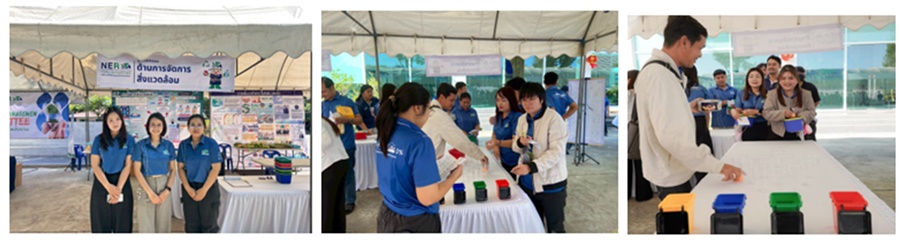
The company has constructed a waste segregation and storage building equipped with systems to support the separation of various types of waste from production and office activities, aimed at enhancing management efficiency and preventing environmental impacts. Segregation is carried out on a regular monthly basis. For waste generated from the production process, employees segregate recyclable waste from other types, weigh it, and record the data before systematically storing it in the waste storage building. For waste originating from employee consumption, the company has set up waste disposal points across various areas within the factory. Each point features 4 bins categorized by waste type as follows:
- Blue bin for general waste
- Yellow bin for recyclable waste
- Green bin for biodegradable waste
- Red Bin for hazardous waste
The company assigns responsible officers to weigh the waste using standard scales and record the data on a daily basis before transferring it to the waste storage building. The waste that can be segregated from the production process and office activities includes old tires, zinc sheets, plastics, cans, scrap metal, paper, and waste from employee consumption such as glass bottles and plastic water bottles. Each type of waste is managed for recovery and utilization both internally within the organization and externally. In 2025, these efforts successfully generated an additional revenue of 1.23 million THB from the sale of the segregated recyclable waste.
The production process generates rubber scraps during the rubber shredding and washing stages prior to entering the drying process. The company has therefore set a target to achieve 100% utilization of these production rubber scraps by feeding them back into the manufacturing process. Employees segregate and collect the rubber scraps into designated containers before reintroducing them into the production line as a component for new rubber products. This initiative reduces raw material loss within the production process and supports internal material circularity practices instead of sending the waste for external disposal. In 2025, a total of 1,354.23 tons of rubber scraps were generated, and 100% of these scraps were entirely reused. As a result, the company successfully reduced its consumption of virgin rubber raw materials, saving 69.74 million THB in raw material procurement costs, and generated 76.68 million THB in value by converting these rubber scraps into finished products.
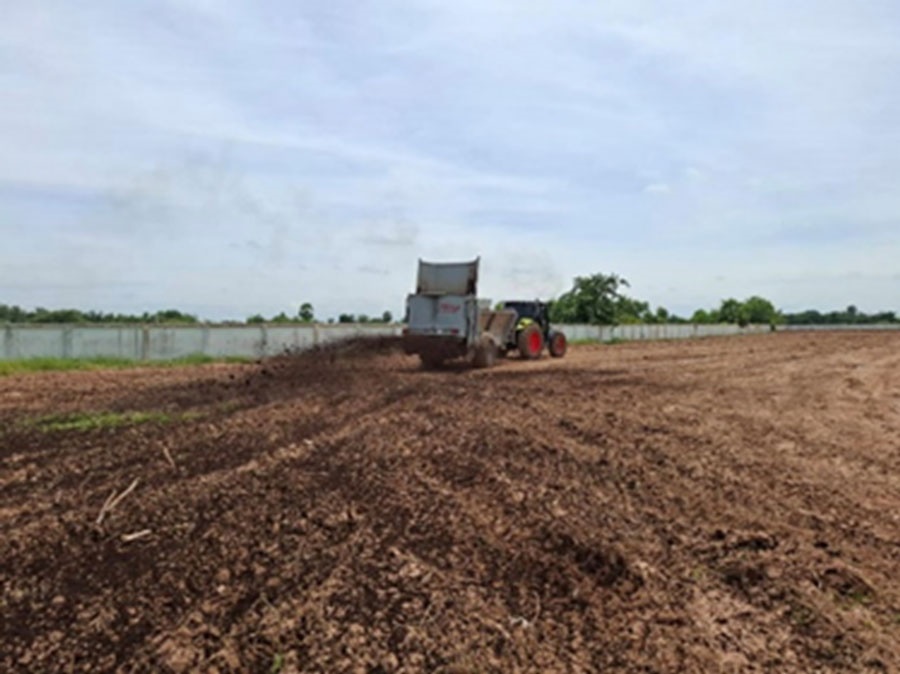
In 2025, the company utilized 459.68 tons of sludge from the biogas production process—which uses Napier grass, cassava pulp, and cow manure as raw materials—as a soil conditioner across a total of 952 rai of the company's Napier grass plantations instead of sending it for external disposal. Utilizing this sludge helps increase organic matter and moisture in the soil, promotes soil quality restoration in the cultivation areas, and supports healthier and more robust growth of the Napier grass.
New Product Development Focusing on Efficient Resource Utilization
The company prioritizes efficient resource utilization and value creation from recoverable materials. Consequently, it has integrated Circular Economy principles into its research, design, and development of new products. This approach aims to reduce virgin raw material consumption, minimize manufacturing waste, and develop products that can be reintroduced as raw materials into the production process at the end of their lifecycle.
In 2025, the company developed rubber flooring mats for livestock stalls and multipurpose rubber flooring mats, designed to suit various applications as follows:
- Rubber flooring mats for livestock stalls or bedding mats for various types of commercial livestock
- Livestock stall rubber flooring mats with a hardness rating of 25 Shore A
- High tear-resistance livestock stall rubber flooring mats
- Multipurpose rubber mats made from recycled materials
The first three products are manufactured entirely from 100% natural rubber. In contrast, the multipurpose rubber mats, which incorporate materials aligned with the circular economy concept, are produced using a blend of natural rubber and recycled rubber. The company's Research and Development department repurposed production rubber scraps and reclaimed rubber as raw materials for manufacturing. This initiative was designed to reduce the consumption of virgin natural rubber, minimize the volume of waste requiring disposal, and add value to recoverable materials, while also contributing to the reduction of GHG emissions and energy consumption in the production process. In 2025, the company successfully reduced its consumption of virgin natural rubber raw materials by 81.13 tons by utilizing these rubber scraps and reclaimed rubber. Furthermore, 100% of all flooring mat products within this category can be reintroduced as primary raw materials into the production process at the end of their lifecycle.
The development process for these products encompasses the segregation, grinding, and property enhancement of the rubber scraps and reclaimed rubber to ensure they can be appropriately reintegrated into the production line. This process maintains product properties that align with practical applications, including strength, elasticity, durability, and operational safety. Every product item has undergone quality testing and has been certified in accordance with the Thai Industrial Standards (TIS). Currently, the company has manufactured and commercially distributed these products, demonstrating its commitment to developing innovative products that satisfy new customer segments, while optimizing resource efficiency, reducing environmental impacts, and tangibly supporting business operations under circular economy principles.
Promoting Employee Participation in Corporate Waste Management
The company prioritizes raising awareness and promoting knowledge regarding waste management among employees across the entire organization. In 2025, the following activities were implemented:
- Morning Talk Activity: Organized every Friday morning by the Environmental Department in collaboration with the Production Department to communicate and educate production employees from the STR1 and STR2 lines. A total of 100 employees rotated to participate according to their shifts before starting work. The sessions focused on communicating guidelines for reducing plastic usage in the production process, proper waste segregation, reinforcing the company's Zero Waste to Landfill target, and continuously informing employees of the plastic waste reduction results to foster enthusiasm in aligning their work with corporate goals. Additionally, the activity sought cooperation from employees to trim the plastic sheets used between rubber layers to perfectly fit the product dimensions right from the initial production stage. This preventive measure avoids excess plastic that would otherwise need to be cut off during the packaging stage, thereby efficiently reducing plastic waste generation within the production process.
- Quiz Activity for Prizes in the "NER Safety & CG Day 2025" Project: The event featured exhibitions and educational activities on environmental management, specifically focusing on household waste management, the segregation of different waste types, and methods for reducing plastic bag waste.
- New Employee Training: Conducted for all new hires to instill knowledge regarding the importance of the environment and relevant direct and indirect corporate policies. A total of 237 new employees participated in and successfully completed the training, representing 100% of all new hires.
Sharing Knowledge and Creating Benefits for Communities and Society
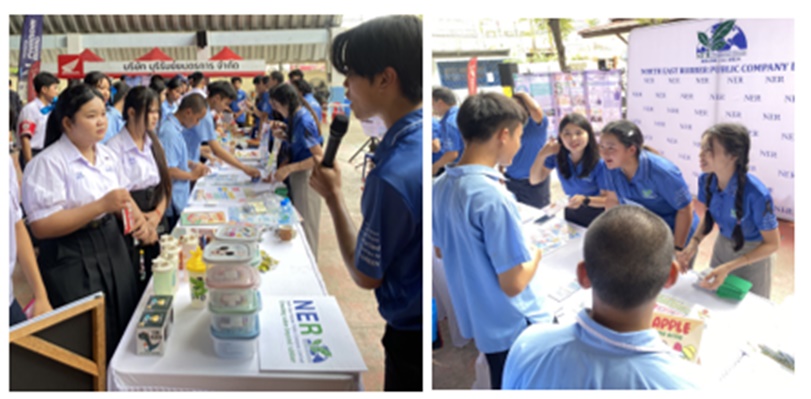
The company is committed to collaborating with government agencies and local communities to share and extend waste management knowledge from within the organization to society. This supports the reduction of pollution from waste at the community level and tangibly promotes stakeholder engagement in environmental care. Consequently, the company focuses on building knowledge, awareness, and participation in proper waste management, encouraging communities to segregate waste at the source, minimize the volume of waste requiring disposal, and enhance opportunities for recovering or adding value to leftover materials.
In 2025, the company participated in the "November 12, Safety Officer at Work Day" event in collaboration with the Buriram Provincial Labour Protection and Welfare Office. The event welcomed over 521 participants, including representatives from government agencies, the general public, and students. In addition to promoting occupational health and safety, the company utilized this opportunity to share waste management knowledge with the community and event attendees. This included topics such as proper waste segregation, household and community waste management, and approaches to recovering leftover materials through recycling or upcycling, all aimed at supporting waste reduction and efficient resource utilization.
Compliance and Complaints Regarding Waste Management
In 2025, the company found no instances of non-compliance with laws and regulations related to waste management, and received no verified complaints regarding such matters. The company remains committed to continuously improving its waste management by focusing on reducing waste generation at the source, increasing the proportion of waste recovery and utilization, and minimizing reliance on landfill disposal. These efforts are aimed at supporting efficient resource utilization, reducing environmental impacts, and mitigating potential impacts on surrounding communities and related stakeholders.
The main goals and notable outcomes of the initiatives focused on waste management are summarized in the table below.
| Long-term Goals 2030 |
2025 Goals |
2025 Performance |
|
|---|---|---|---|
| Percentage of waste to landfill to total waste | 0% | Not exceeding 10% | 17.22% |
| Percentage of recyled waste to total waste | 100% | More than 95% | 82.24% |